Thousands of Blue Dots
View the printable version of this newsletter.
Hi Village,
Three weeks, three numbers: 495 in-person contacts, presentations, and emails; 43 joined the village (8.5%). Thank you.
What stayed with me wasn’t those numbers but the pattern in the conversations. People were angry, sometimes hopeless, about the US health system. Then, in the same breath, they’d light up, describing what people with lived experience have done for themselves and the people they love, without the system’s help. Anger at the system, real faith in the person inside it. That’s the tension we built TMOH for.
The best talk on the trip was Sara Riggare’s ISDM keynote, “The Blue Dots.” Sara has lived with Parkinson’s since she was 13. (Full talk: https://youtu.be/ZxZXDrHQnz8)
Her image: one hour a year with a neurologist, the red dot. The other 8,765 hours, managing the condition herself: thousands of blue dots. Healthcare has built decades of frameworks for the red dot, almost nothing for the blue dots. That knowledge, when to try a rollator, how to read your own body’s warnings, mostly disappears the moment you leave the room. Sara calls this epistemic injustice: your own knowledge doesn’t count as knowledge, regardless of what you’re allowed to decide.
I ran my own numbers, counting travel time along with the visit itself. Medical care alone comes to 356 hours a year for me, 4%, a red dot roughly 357 times the size of Sara’s. Add massage, chiropractic, and acupuncture, and it’s 1,210 hours, 14%. I called that second group “self-care” until I looked closer; it’s still someone else’s hands, someone else’s schedule. The truly self-managed hours, no practitioner at all, come to 7,555, 86% of my year.
A personal health data vault holds the blue dots too: the small experiments and adjustments that live only in memory and vanish unspoken, not just the red-dot artifacts of lab results and visit summaries.
At the ISDM conference, a poet wrote about TMOH and asked to enlist as a “healthy” use case. She’s getting married; she and her husband want a vault for themselves and eventually their kids, built from the start rather than after something goes wrong. Same shift Sara is describing: care that lives in ordinary life, not just crisis.
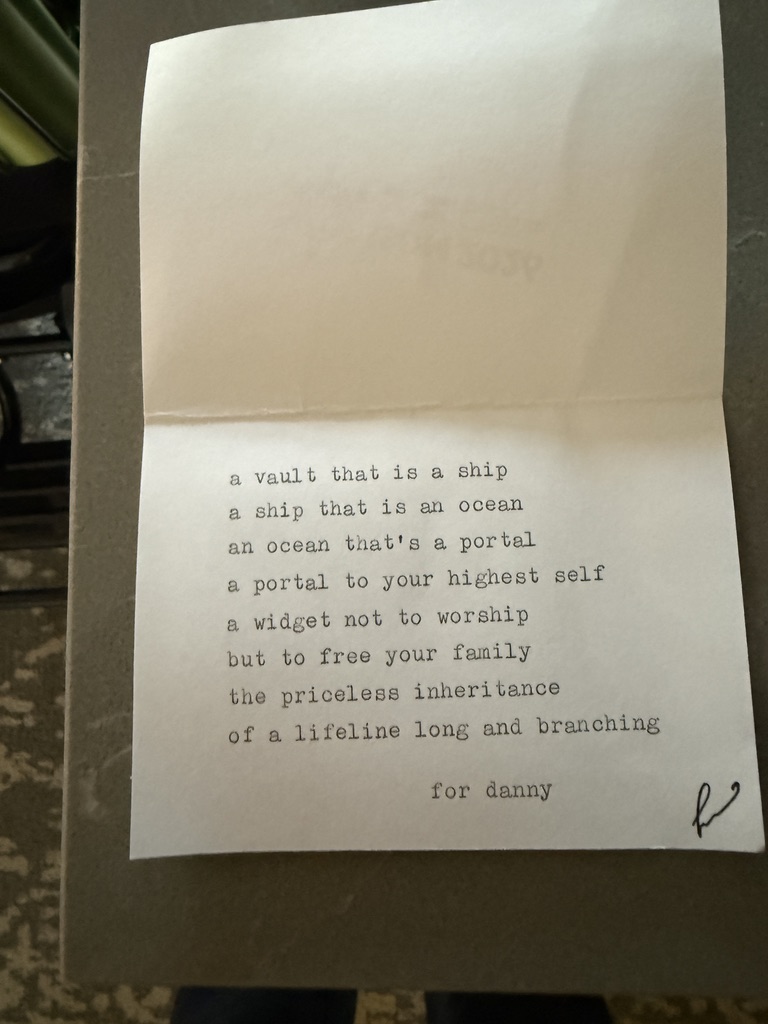
Almost everyone I spoke with called TMOH a bold long shot. I don’t argue anymore; it is. But a long shot isn’t the same as wrong. The knowledge already exists, in millions of hours of lived experience. TMOH is building the place to hold it.
Comments from the Village
Bob suggested I protect the Task Wheel’s IP. I’ll use a Creative Commons CC BY-NC license: free to use and adapt, but not for commercial purposes.Please refer friends and colleagues to subscribe.
Best health for where you are, with what you have, right now.
Onward, Danny